A public accountability record of the Islamic Republic of Iran
Data as of
01/Overview/Data as of
The Iran Ledger · Middle East Forum
The Islamic Republic of Iran’s Crimes against Humanity
This record documents the regime’s killings, executions, torture and mass detention of its own people. It names the officials, forces and companies that carry them out and pay for them, and shows whether the United States, the European Union, the United Kingdom, Canada and Australia have sanctioned each one.
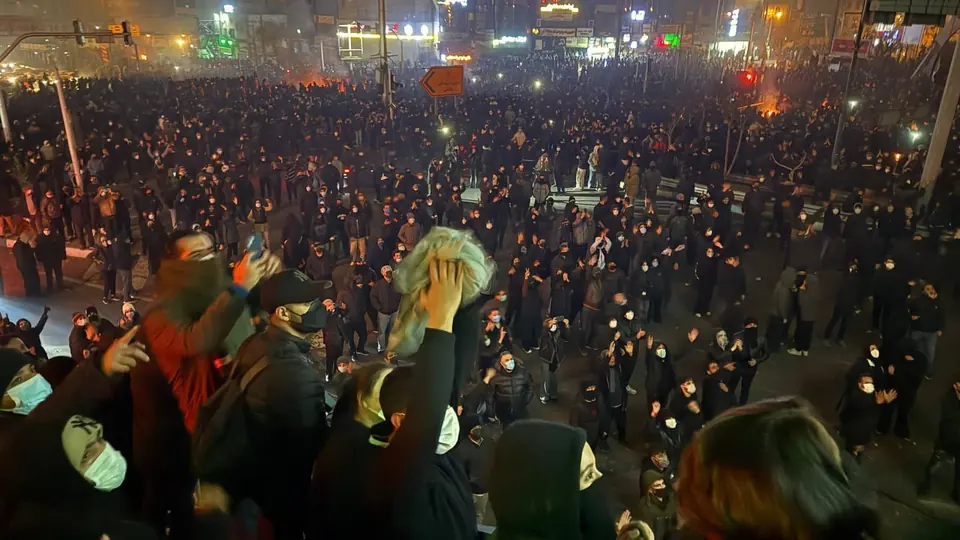
Crowds fill a street in Poonak, Tehran, on the night of January 9, 2026, the second day of the nationwide communications blackout. Photo: VahidOnline (anonymous contributor), CC0, via Wikimedia Commons
Report title card
New Report · Updated
Blood Money: Crimes against Humanity in Iran
Between December 28, 2025, and February 2026 the Islamic Republic answered the largest popular uprising since 1979 with live fire, a nationwide communications blackout and mass arrests. The report documents the killings, detentions and executions, traces the chain of command from the Supreme Leader through the IRGC, the Basij and the Revolutionary Courts, and identifies the revenue that sustains it. It finds that these acts satisfy the elements of crimes against humanity under Article 7 of the Rome Statute.
The Ledger’s data rest on a documented pattern of state violence. Six parts of that record follow, each tied to a primary source: a UN document, a government or court record, or the documenting organization’s own report.
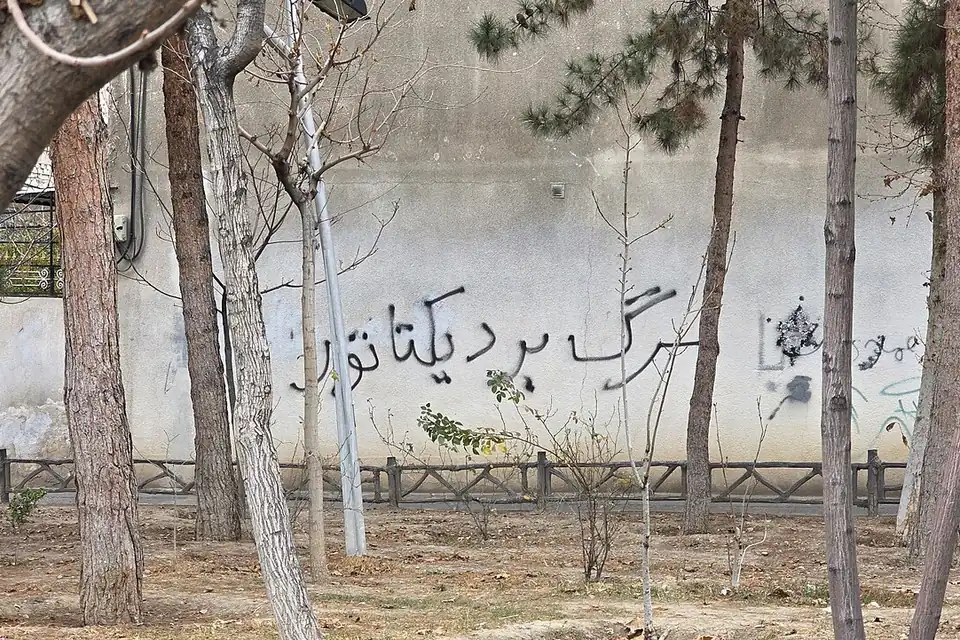
Graffiti reading "Death to the dictator" on a wall in Iran, January 2026. Photo: Hosseinronaghi, CC BY 4.0, via Wikimedia Commons
The January 2026 Massacres
After the authorities cut internet and telephone service on January 8, 2026, security forces fired on protesters in all 31 provinces. The government’s own figure is 3,038 dead.Source 1 Iran Human Rights has identified 4,219 of the dead by name, 281 of them children.Source 2 The UN Fact-Finding Mission found in September 2026 that many of the violations amount to the crimes against humanity of murder, imprisonment, torture and other inhumane acts.Source 1
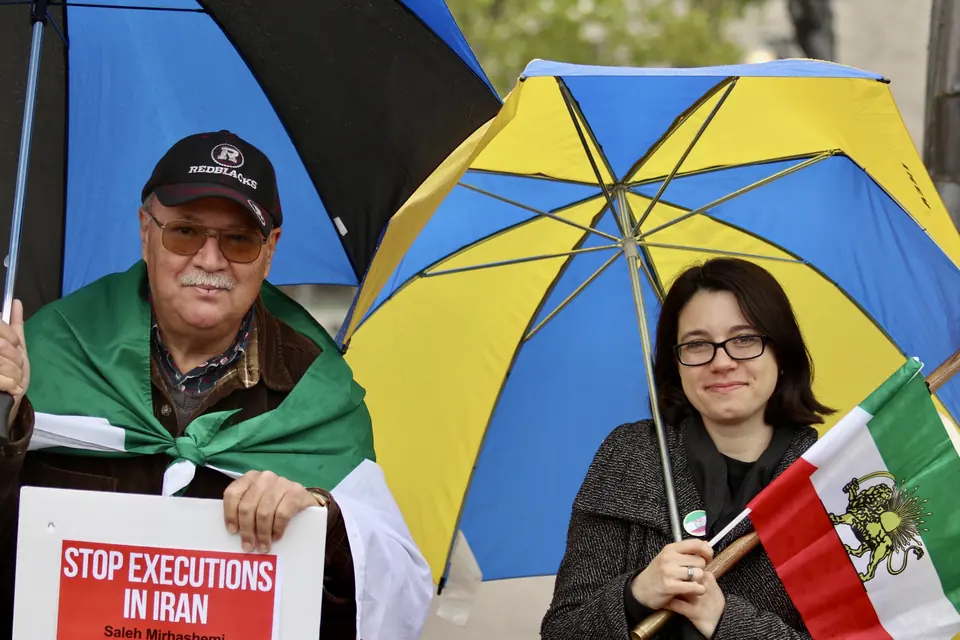
A rally under the banner "United Against Executions in Iran," May 20, 2023. Photo: Taymaz Valley, CC BY 2.0, via Wikimedia Commons
Mass Executions
The Abdorrahman Boroumand Center recorded at least 2,113 executions in 2025, up from 941 in 2024.Source 4 Human Rights Watch calls the 2025 figure the highest known annual number since the late 1980s.Source 5 On September 30, 2026, over 40 states told the UN Human Rights Council that at least 31 protesters had been executed since the January crackdown.Source 6
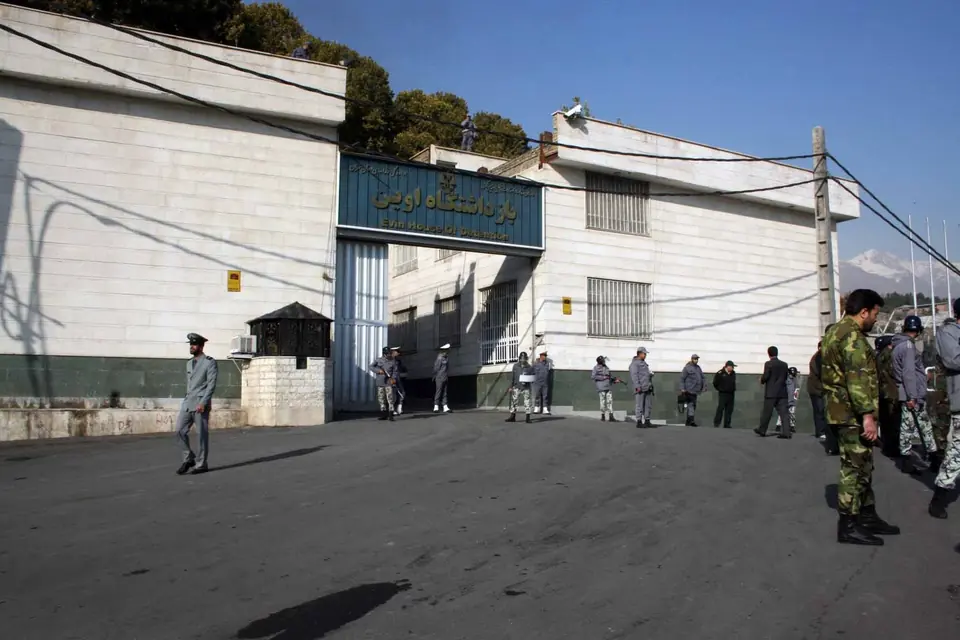
The entrance to Evin House of Detention, Tehran, August 2008. Photo: Ehsan Iran, CC BY-SA 2.0, via Wikimedia Commons
The 1988 Prison Massacre
Between July and September 1988 the authorities forcibly disappeared and extrajudicially executed thousands of imprisoned political dissidents in secret, and buried most of them in unmarked mass graves. Amnesty International calls the killings ongoing crimes against humanity.Source 7 On October 3, 2026, the authorities demolished one of the last watchtowers at Gohardasht (Rajaei Shahr) prison, a site of the executions, despite warnings that this could erase evidence.Source 8
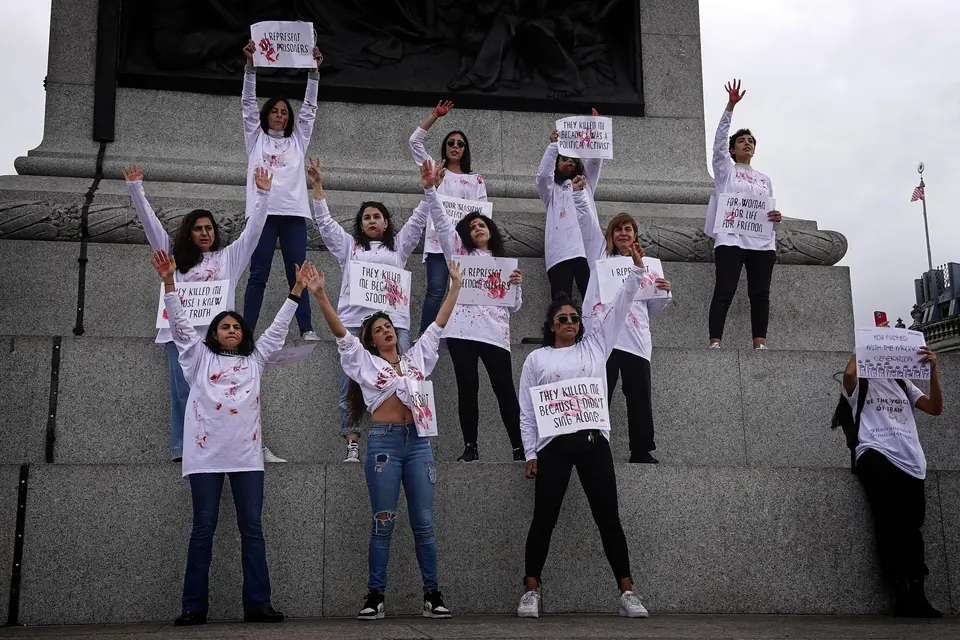
Women protest in London in solidarity with Mahsa Amini, October 2022. Photo: Garry Knight, CC0, via Wikimedia Commons
Woman, Life, Freedom, 2022
Protests followed the death in custody of Jina Mahsa Amini in September 2022. The UN Fact-Finding Mission put the credible death toll at 551, including 49 women and 68 children, and found that the repression amounted to crimes against humanity, including persecution on the grounds of gender (A/HRC/55/67, March 2024).Source 9 In September 2026 Amnesty International named 87 officials it says should be investigated for those crimes.Source 10
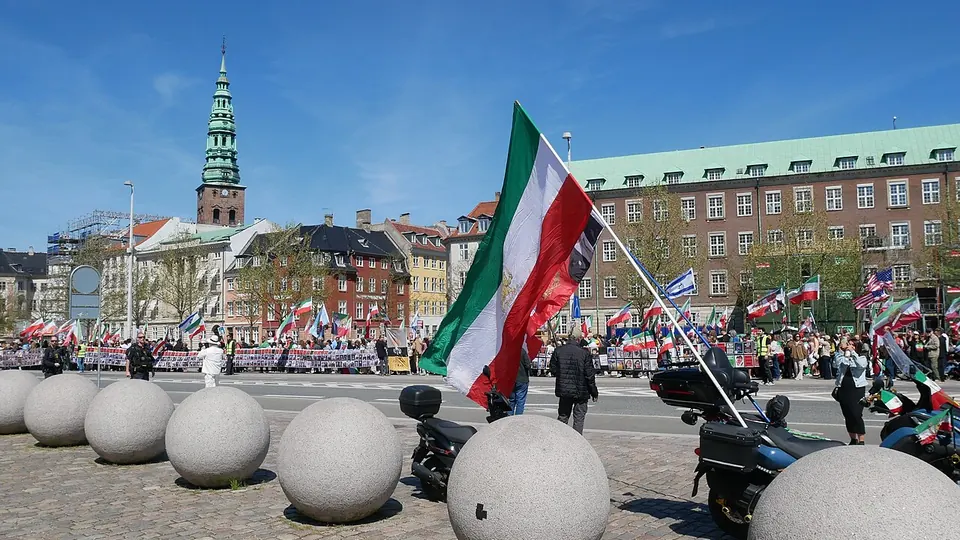
Iranian exiles march against the regime in Copenhagen, May 9, 2026. Photo: Doyle of London, CC BY-SA 4.0, via Wikimedia Commons
Persecution of Minorities
The UN mission found that the gender persecution of 2022 intersected with discrimination on the basis of ethnicity and religion.Source 9 Amnesty International found that the authorities disproportionately targeted Kurdish and Baluchi communities with lethal force, subjecting them to the crime against humanity of persecution.Source 10 In May 2026 the Center for Human Rights in Iran documented arbitrary arrests, home raids, enforced disappearances and property seizures against Baha’is, Iran’s largest non-Muslim religious minority.Source 11
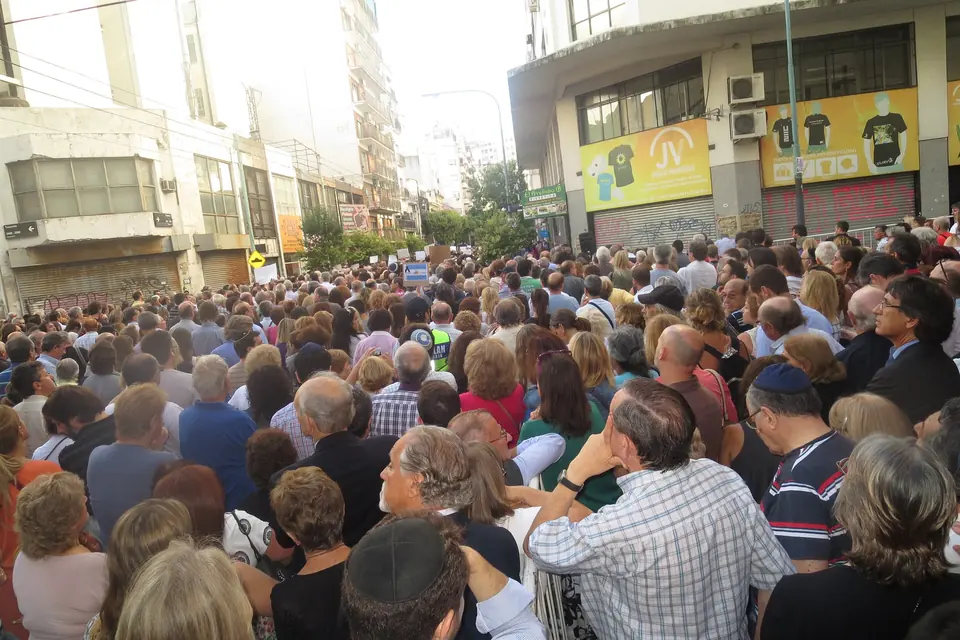
The annual commemoration of the 1994 AMIA bombing, Buenos Aires, July 18, 2015. Photo: Jaluj, CC BY-SA 4.0, via Wikimedia Commons
Repression beyond Iran’s Borders
On September 21, 2026, an Argentine federal judge charged eight Iranian and Lebanese nationals, among them Ahmad Vahidi, now commander-in-chief of the IRGC, and Mohsen Rezaei, over the 1994 bombing of the AMIA Jewish community center in Buenos Aires, which killed 85 people, and ordered US$500 million in assets seized from each defendant.Source 12 The UN Fact-Finding Mission reports that Iran’s transnational repression has left victims and witnesses afraid of reprisals for cooperating with investigators.Source 1
Sources for This Section
United Nations Human Rights Council, Report of the Independent International Fact-Finding Mission on the Islamic Republic of Iran, A/HRC/63/61, advance unedited version, September 14, 2026, paras. 5, 30, 31, 119 and 121. ecoi.net
Iran Human Rights (IHRNGO), The January 2026 Protest Killings in Iran, September 17, 2026, 4,219 victims identified by name, including at least 420 women and 281 children. iranhr.net
Human Rights Activists News Agency (HRANA), “The Crimson Winter: A 50-Day Record of Iran’s 2025-2026 Nationwide Protests,” February 23, 2026. en-hrana.org
Abdorrahman Boroumand Center for Human Rights in Iran, reported executions by year (2,113 in 2025; 941 in 2024), accessed October 5, 2026. iranrights.org
Human Rights Watch, “Iran: Ongoing Unlawful Execution Campaign against Protesters,” September 10, 2026. hrw.org
Joint statement on the death penalty in Iran, delivered by Liechtenstein on behalf of over 40 states, UN Human Rights Council, 63rd session, September 30, 2026, as published by the Norwegian Mission in Geneva. norway.no
Amnesty International, Blood-Soaked Secrets: Why Iran’s 1988 Prison Massacres Are Ongoing Crimes against Humanity, MDE 13/9421/2018, December 4, 2018. amnesty.org
Iran International, “Iran Demolishes Prison despite Warnings of Erasing Evidence of Mass Killings,” October 4, 2026. iranintl.com
United Nations Human Rights Council, Report of the Independent International Fact-Finding Mission on the Islamic Republic of Iran, A/HRC/55/67, presented at the 55th session (February 26 to April 5, 2024), paras. 22 and 108. documents.un.org
Amnesty International, “Iran: Architects of Crimes against Humanity to Suppress Protests Must Face Justice,” September 16, 2026 (report MDE 13/1348/2026). amnesty.org
Center for Human Rights in Iran, “Iran’s Baha’i Community under Intensified State Attack amid Escalating Domestic Repression,” May 19, 2026. iranhumanrights.org
Buenos Aires Herald, “Argentina Charges Iran’s Revolutionary Guard Chief and Others over AMIA Bombing,” September 22, 2026. buenosairesherald.com
How the Ledger Works
The Ledger lists the people and entities documented as committing or financing these crimes and checks each one against the official sanctions lists of the United States, the European Union, the United Kingdom, Canada and Australia. Where a jurisdiction has screened a documented party and not designated it, the Ledger records an open gap. Every entry links to its source, and every figure carries its as-of date.
Reading a Ledger Row
July 14, 2026
Designated, stamped with the date the seal was struck.
Open Gap
Documented here; screened by that jurisdiction; not designated.
·
No record found either way. An absence of evidence, not a finding.
The Ledger in Figures
959Public Profiles in the RegisterPeople, forces and companies documented as committing or financing the regime’s crimes.Open the Entity Register
905Designation Events, Five Jurisdictions62 sanctions actions, December 28, 2025, to October 6, 2026. One row per party per jurisdiction per date.See the Designation Record
259Open GapsDocumented parties a screened jurisdiction has not designated, across 58 profiles.Open the Gap Map
42Profiles Open in All FiveDocumented, screened, and designated by none of the five jurisdictions.See the Widest Gaps
Ledger · Five jurisdictions ·Data as of October 6, 2026
Highest-Leverage Rows: Divestment Priority, Then Widest Gap
The record opens on December 28, 2025, when protests began in Tehran’s Grand Bazaar, and runs to the day of publication. This edition was refreshed on October 4, 2026. Between those dates sit a nationwide communications blackout, a contested death toll no two monitors count the same way, two rounds of open war, a memorandum of understanding that collapsed inside a month, and a summer of executions that did not pause for any of it. This tracker keeps those things apart on purpose: keeping the four bodies of evidence separate means a war casualty is never added to a crackdown figure, and an execution on a war-related charge stays in the repression record, because it is an act of the judiciary.
CrackdownNationwide protests erupt, beginning with shopkeepers in Tehran's Grand Bazaar after a sharp collapse of the rial
CrackdownTotal internet, mobile and landline communications shutdown imposed nationwide, isolating over 90 million people
CrackdownPeak of the crackdown; Amnesty describes "massacres" and mass unlawful killings carried out primarily on these two days
CrackdownFirst detailed official toll: 3,117 killed (France24); the government later settled on 3,038 (UN FFM)
CrackdownHRANA publishes its consolidated 50-day record, "The Crimson Winter"
War Round 1WAR BEGINS. US and Israel launch a new wave of airstrikes on Iran; second nationwide internet shutdown begins (88 days, restored May 26, 2026)
War Round 1Ceasefire deal
War Round 1Internet access begins to be restored after the 88-day wartime shutdown
MOU interimIslamabad MOU signed; the interim period runs to OFAC’s revocation of General Licence X on July 7, 2026.
War Round 2War Round 2 opens after the MOU collapses; kept as its own record even though its dates fall inside the post-MOU window.
DesignationsIran-related Designations; Iran-related and Counter Terrorism Designation Update; Issuance of Iran-related General License: 54 designation events.
This recordAugust edition. Every figure above carries its source on the page that reports it.
This recordRefreshed edition, data as of October 6, 2026.
Full definitions, per-source figures and the variance doctrine are on Repression; the designation actions behind the last rows are on the Sanctions Monitor.
The Sections
Eleven sections, read in order or entered at any point. Every page carries its section number, its as-of date and a link to the next section.


.jpg)

.jpg)
.jpg)
